Why Your Dental Practice Isn’t Ranking on Google
If your dental practice is not showing up on Google when people search for “dentist near me,” “emergency dentist,” “dental implants,” or “Invisalign in [your city],” the problem is usually not one single thing.
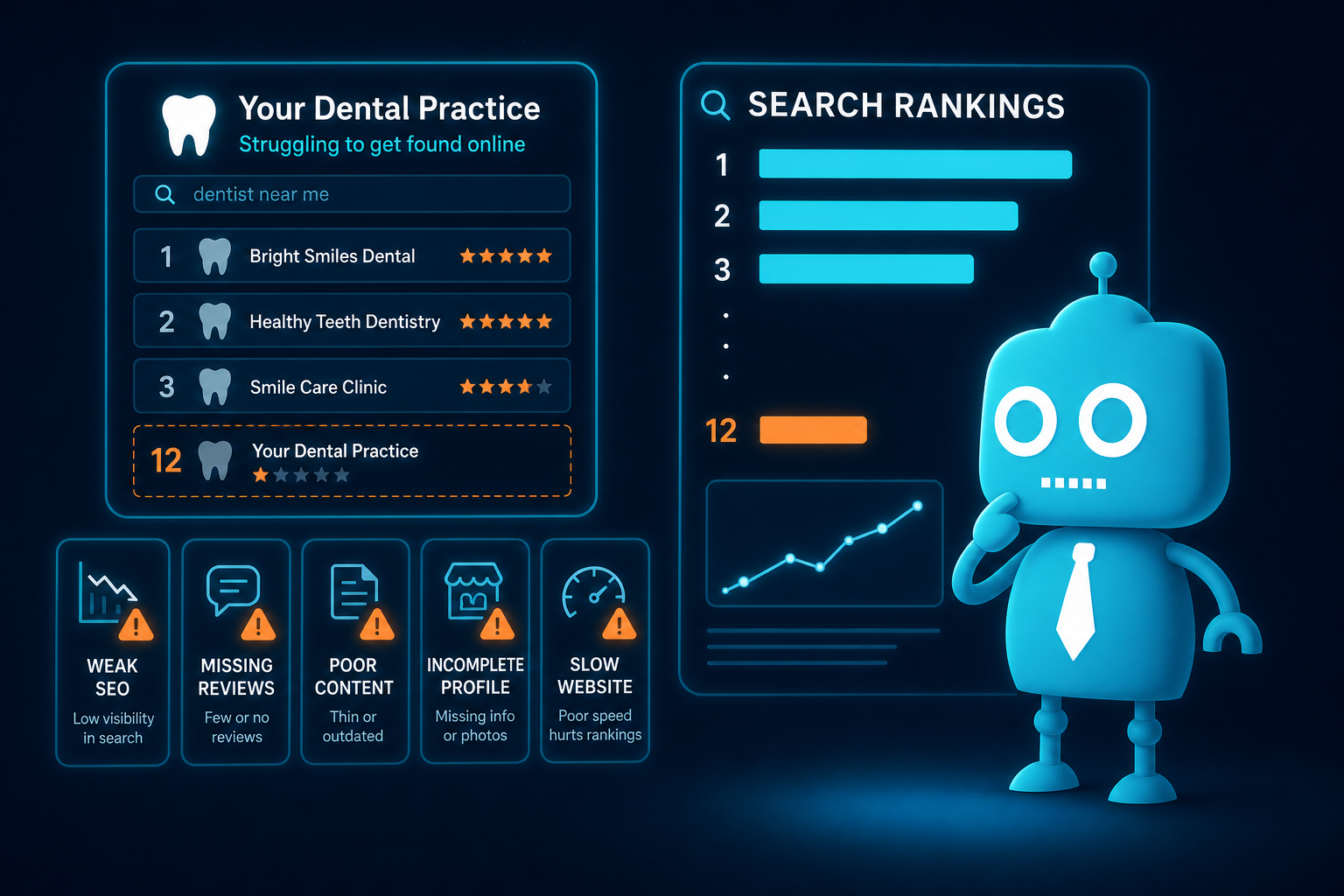
It is often a combination of weak local SEO signals, an underperforming website, limited reviews, poor content, and stronger competitors who are doing the basics better.
Think of this like diagnosing a patient. You would not recommend treatment without identifying the cause of the problem. The same applies to your dental marketing. If your practice is not ranking, you need to diagnose the specific issues holding you back.
Below are the most common reasons independent dental practices struggle to rank on Google, along with practical ways to fix them.
1. Your Google Business Profile Is Weak or Incomplete
For most dental practices, the Google Business Profile is one of the most important ranking assets. This is what appears in Google Maps and the local “map pack” when patients search for a nearby dentist.
If your profile is incomplete, outdated, or barely optimized, Google has less confidence showing your practice above competitors.
Common Google Business Profile Problems
- Your primary category is incorrect or too broad
- Your business description is generic or missing key services
- Office hours are outdated or inconsistent
- Photos are old, low-quality, or missing
- Services are not fully listed
- There are few recent posts or updates
- Your appointment link goes to a poor landing page or generic contact form
For example, if you offer same-day emergency dental care, dental implants, clear aligners, pediatric dentistry, or cosmetic dentistry, those services should be clearly reflected in your profile. Patients and Google both need to understand what you provide.
How to Fix It
Make sure your Google Business Profile includes accurate categories, service areas, business hours, photos of your office and team, service descriptions, and a clear link to schedule an appointment.
Your profile should also support front desk operations. If a patient clicks “call” or “book,” the experience should be smooth. Missed calls, slow follow-up, or confusing forms can turn ranking visibility into lost opportunities.
2. You Do Not Have Enough Recent Patient Reviews
Reviews are one of the strongest trust signals for dental practices. They influence both rankings and patient decisions.
A practice with 37 reviews and a 4.6-star rating will often struggle against a nearby competitor with 350 reviews, frequent new reviews, and thoughtful owner responses.
Why Reviews Matter for Dental SEO
Google wants to recommend businesses that appear trustworthy, active, and relevant. For dental practices, reviews help show that real patients are choosing your office and having positive experiences.
Reviews also influence conversion. A new patient comparing three dentists is likely to choose the office with more recent, detailed reviews that mention specific treatments, friendly staff, gentle care, or easy scheduling.
Where Dental Practices Fall Short
- They only ask for reviews occasionally
- The front desk is too busy to manually follow up
- There is no automated SMS or email review request system
- Review requests are sent too late after the visit
- The practice does not respond to reviews consistently
How to Fix It
Create a repeatable review workflow. For example, after a hygiene appointment, cosmetic consultation, emergency visit, or completed treatment plan, your CRM or practice management system can trigger a review request by SMS or email.
The easier you make it for happy patients to leave a review, the more consistent your review growth becomes. Your team should not have to rely on memory or sticky notes at the front desk.
3. Your Website Structure Is Confusing Google and Patients
Poor site structure is one of the most overlooked reasons dental websites do not rank.
If your services are buried, your navigation is unclear, or multiple pages compete for the same keyword, Google may struggle to understand which pages should rank.
What Poor Dental Website Structure Looks Like
- All services listed on one long page instead of individual service pages
- No clear pages for high-value treatments like implants, veneers, Invisalign, or emergency dentistry
- Duplicate or overlapping pages targeting the same terms
- No internal links between related services
- No clear path from service information to appointment scheduling
For example, if your practice wants to rank for “dental implants in Phoenix,” you need a dedicated dental implants page that explains the treatment, answers common patient questions, highlights your approach, and includes a clear call-to-action.
A single bullet point on a general “Services” page is usually not enough.
How to Fix It
Build a clear website structure around your core services and location. A strong dental website should usually include pages such as:
- General Dentistry
- Preventive Dentistry
- Emergency Dentistry
- Cosmetic Dentistry
- Dental Implants
- Clear Aligners or Invisalign
- Teeth Whitening
- Veneers
- Restorative Dentistry
- New Patient Information
- Insurance and Financing
- Contact or Appointment Request
Each page should have a purpose: rank, educate, build trust, and move the visitor toward scheduling.
4. Your Service Pages Are Too Thin
Thin service pages are a major ranking problem for dental practices.
A page that says “We offer dental implants. Call us today” does not give Google or patients enough information. It also does not differentiate your office from every other dentist in the area.
What a Strong Dental Service Page Should Include
- A clear explanation of the treatment
- Who the service is for
- Common symptoms or patient concerns
- Your process or technology
- Benefits and expected outcomes
- Frequently asked questions
- Insurance, financing, or payment guidance where appropriate
- Trust elements such as reviews, photos, or doctor credentials
- A clear appointment request form or call button
For example, an emergency dentistry page should explain what counts as a dental emergency, whether same-day appointments are available, what patients should do if they have a knocked-out tooth, and how quickly your front desk responds to requests.
This type of page is more helpful to patients and more useful to Google.
5. You Have No Local Content
Dental SEO is local. Your patients are not just searching for “teeth whitening.” They are searching for “teeth whitening near me,” “dentist in [city],” or “emergency dentist open today in [neighborhood].”
If your website does not include local signals, Google may not connect your practice strongly enough with your city, neighborhood, or service area.
Examples of Local Content for Dental Practices
- A page for your main city or neighborhood
- Directions and parking information for your office
- Content about serving nearby communities
- Blog posts answering local patient questions
- Information about local insurance plans or employers, where appropriate
- Community involvement, sponsorships, or school programs
For example, a practice in Austin might create helpful content around “What to Do If You Need an Emergency Dentist in South Austin” or “Dental Implant Consultations in Austin: What New Patients Should Know.”
The goal is not to stuff city names everywhere. The goal is to create useful, locally relevant content that matches how real patients search.
6. Your Website Is Too Slow
Website speed affects both rankings and conversions. If your dental website takes too long to load, patients may leave before they ever see your phone number or appointment form.
This is especially important for mobile searches. Someone with a toothache searching for an emergency dentist is not going to wait for a slow website to load.
Common Causes of Slow Dental Websites
- Oversized images
- Outdated WordPress themes or plugins
- Cheap or overloaded hosting
- Too many tracking scripts
- Unoptimized videos
- Poor caching setup
How Slow Speed Hurts New Patient Acquisition
A slow site can reduce appointment requests, increase bounce rates, and make your practice look outdated. Even if your clinical care is excellent, a poor digital experience can create doubt before a patient ever calls.
Speed is not just a technical issue. It is a patient experience issue.
7. Your Mobile Experience Is Poor
Most dental searches happen on mobile devices. Patients are searching during lunch breaks, after work, from the car, or while dealing with a dental emergency.
If your website is difficult to use on a phone, you are likely losing new patients.
Signs of a Poor Mobile Dental Website
- Phone number is hard to find
- Appointment form is too long
- Buttons are too small to tap
- Text is difficult to read
- Pages require excessive scrolling
- Insurance or financing information is buried
- Maps and directions are hard to access
A mobile-friendly dental website should make the next step obvious. Patients should be able to call, request an appointment, get directions, or send a message without frustration.
Practical Mobile Conversion Example
If a patient lands on your emergency dentistry page from Google, the page should quickly show:
- Your phone number
- A same-day appointment message if available
- A short emergency appointment form
- Your office location
- What types of emergencies you treat
Mobile design should support the way real patients make decisions.
8. Your NAP Information Is Inconsistent
NAP stands for name, address, and phone number. Google uses this information to verify your practice across the web.
If your practice name, address, or phone number appears differently across directories, insurance listings, social profiles, and local citations, it can weaken your local SEO trust signals.
Common NAP Issues for Dental Practices
- Old phone numbers still appearing online
- Previous office addresses listed on directories
- Different versions of the practice name
- Suite numbers missing or formatted inconsistently
- Doctor name used instead of practice name on some listings
- Multiple outdated listings after a practice acquisition or rebrand
This is especially common when a practice changes ownership, moves locations, adds a second office, or updates its brand.
How to Fix It
Audit your major listings, including Google, Bing, Apple Maps, Yelp, Healthgrades, WebMD, Facebook, insurance directories, and local business directories. Make sure your NAP is consistent everywhere.
For multi-location dental groups, each location should have its own consistent NAP, location page, Google Business Profile, and appointment pathway.
9. Your Competitors Are Stronger Online
Sometimes your practice is not doing anything “wrong.” Your competitors may simply be doing more of the right things.
If another dental practice has a stronger website, more reviews, better service pages, faster loading speed, more local content, and a more active Google Business Profile, they are giving Google more reasons to rank them higher.
What Stronger Dental Competitors Usually Have
- Hundreds of positive reviews
- Dedicated pages for each major service
- Clear local SEO targeting
- Fast, mobile-friendly websites
- Professional photos and doctor bios
- Consistent content publishing
- Strong calls-to-action
- Online scheduling or easy appointment requests
- Automated follow-up by SMS or email
Ranking on Google is competitive because new patients are valuable. A single dental implant case, Invisalign patient, or family of four can generate significant lifetime value. Practices that understand this invest in their online presence accordingly.
How to Compete
Do not copy your competitors. Diagnose what they are doing better, then build a stronger version that reflects your own practice.
For example, if a competitor has a great dental implants page but no helpful follow-up process, you can improve your own page and connect it to a lead capture form, CRM, automated consultation reminders, and front desk notification workflow.
Ranking is important, but converting that traffic into scheduled appointments is what actually grows the practice.
10. You Do Not Have a Content Strategy
Many dental practices publish content randomly, if at all. One month they post about teeth whitening. Six months later they post a short article about brushing tips. Then nothing happens for a year.
That is not a content strategy.
A strong dental SEO strategy uses content to support the services, locations, and patient questions that matter most to your practice.
What a Dental Content Strategy Should Include
- Core service pages for high-value treatments
- Local pages for your city, neighborhood, or service area
- Blog posts that answer common patient questions
- Content for different stages of the patient journey
- Internal links from blogs to service pages
- Clear calls-to-action on every important page
- Regular updates based on search trends and practice goals
Practical Dental Blog Topics
- How Much Do Dental Implants Cost in [City]?
- When Is a Toothache a Dental Emergency?
- Invisalign vs. Braces: Which Is Better for Adults?
- What to Expect at Your First Dental Visit
- Does Dental Insurance Cover Crowns?
- How Long Do Veneers Last?
- Why Are My Gums Bleeding When I Brush?
These topics are not just for traffic. They help educate patients, reduce front desk repetition, support treatment acceptance, and move visitors closer to booking.
Ranking Is Only Part of the Problem
Getting found on Google matters, but ranking alone does not guarantee growth.
If your website gets traffic but patients do not call, submit forms, schedule appointments, or receive timely follow-up, your marketing is leaking opportunities.
Dental SEO should connect directly to new patient acquisition. That means your website, Google Business Profile, CRM, forms, SMS reminders, email follow-up, and front desk workflow should all work together.
Ask These Questions
- Can a new patient request an appointment in under one minute?
- Does the front desk receive form submissions instantly?
- Are missed calls tracked?
- Are leads followed up by SMS or email?
- Are review requests automated after appointments?
- Do service pages answer the questions patients ask every day?
- Does your website make your practice look modern and trustworthy?
If the answer is no, your ranking problem may also be a conversion problem.
How to Diagnose Your Dental Practice’s Google Ranking Problem
Before spending more money on ads or redesigning your website, start with a practical diagnosis.
Use This Quick Checklist
- Search your main services and city: Are you visible?
- Check your Google Business Profile: Is it complete and active?
- Compare your reviews to top competitors
- Review your website navigation and service pages
- Test your website speed on mobile
- Submit your own appointment form and see what happens
- Call your office from mobile search and evaluate the experience
- Check whether your NAP is consistent across directories
- Look at competitor websites and identify gaps
- Review whether you have a real content plan
This process usually reveals the real blockers. Some practices need stronger reviews. Some need better service pages. Others need faster hosting, improved mobile design, better lead capture, or a complete local SEO cleanup.
Build a Website and SEO Foundation That Brings in More New Patients
Your dental practice does not need a generic website that simply looks nice. You need a digital foundation that helps patients find you, trust you, contact you, and follow through with an appointment.
That means your website should support Google rankings, patient education, lead capture, front desk efficiency, and follow-up.
If your practice is not ranking on Google, the solution is rarely a quick trick. It is usually a smarter system: stronger local SEO, better content, faster performance, mobile-first design, consistent reviews, and better conversion workflows.
How CreateTheSite.com Helps Dental Practices Rank and Convert
CreateTheSite.com helps dental practices build modern, high-performing websites designed for visibility, trust, and new patient growth.
Our team supports dental practices with modern website design, reliable hosting, mobile optimization, lead capture forms, CRM integrations, SMS and email automation, appointment follow-up, and ongoing website support.
Whether your current website is outdated, slow, difficult to manage, or not converting visitors into appointments, CreateTheSite.com can help you create a stronger online presence that supports both your marketing and your front desk operations.
If you want your dental website to do more than sit online, CreateTheSite.com can help turn it into a practical growth tool for your practice.
Ready to improve your dental practice’s website and new patient experience? Visit CreateTheSite.com to learn how we can help.