
Why Reputation Is Becoming More Important Than Advertising
Advertising can put your dental practice in front of more people. Reputation determines whether those people trust you enough to book.
That distinction matters more than ever for independent dental practices. Patients are not responding to ads in isolation. They are checking Google reviews, scanning your website, comparing nearby dentists on Google Maps, asking friends, and looking for signs that your office is professional, responsive, and trustworthy.
In other words, advertising creates awareness. Reputation converts awareness into appointments.
For dentists, office managers, and practice owners focused on new patient acquisition, this shift changes the way marketing should be planned. A bigger ad budget will not fix weak reviews, outdated website design, poor mobile experience, slow follow-up, or inconsistent front desk communication. Those issues create friction between interest and booking.
To grow consistently, your practice needs more than visibility. It needs trust signals at every step of the patient journey.
Patients Now Search Reviews Before They Choose a Dentist
Dental care is personal. Patients are trusting your team with their health, comfort, appearance, finances, and sometimes anxiety. That makes reputation especially important in dentistry.
Most prospective patients do not simply click the first dental ad they see and schedule immediately. Instead, they behave in a review-first way. They notice your practice, then verify whether you are worth contacting.
What Review-First Behavior Looks Like
A typical new patient journey may look like this:
- A patient searches “dentist near me,” “emergency dentist,” or “Invisalign dentist in [city].”
- They see a Google Ad, Google Maps listing, or organic search result.
- They compare star ratings, review count, photos, and location.
- They click into your Google Business Profile.
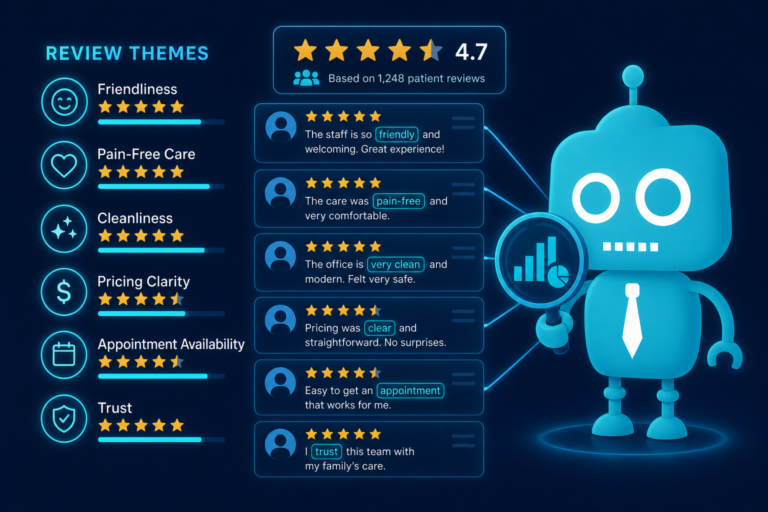
- They read recent reviews, especially reviews mentioning friendliness, pain-free care, insurance, wait times, and results.
- They visit your website to confirm services, credibility, and appointment options.
- They decide whether to call, submit a form, or keep comparing.
This means your reputation is part of your conversion funnel. If your reviews are weak, outdated, inconsistent, or hard to find, your advertising may generate attention but fail to produce enough appointments.
Advertising Gets the Click, But Reputation Gets the Call
Many dental practices think of advertising as the main driver of new patients. It is important, but it is only one part of the decision process.
For example, imagine two practices running ads for dental implants in the same city.
- Practice A has a modern website, 4.9 stars, 350 Google reviews, patient testimonials, before-and-after case examples, clear financing information, and fast follow-up.
- Practice B has a basic website, 3.8 stars, 42 reviews, no testimonials, limited service details, and a contact form that may not be answered until the next day.
Both practices may get impressions. Both may get clicks. But Practice A is far more likely to earn the consultation because the patient feels safer taking the next step.
This is why reputation has become a performance factor in dental marketing. It affects whether paid advertising, SEO, Google Maps visibility, and website traffic actually turn into booked appointments.
The Trust Signals Patients Look For Before Booking
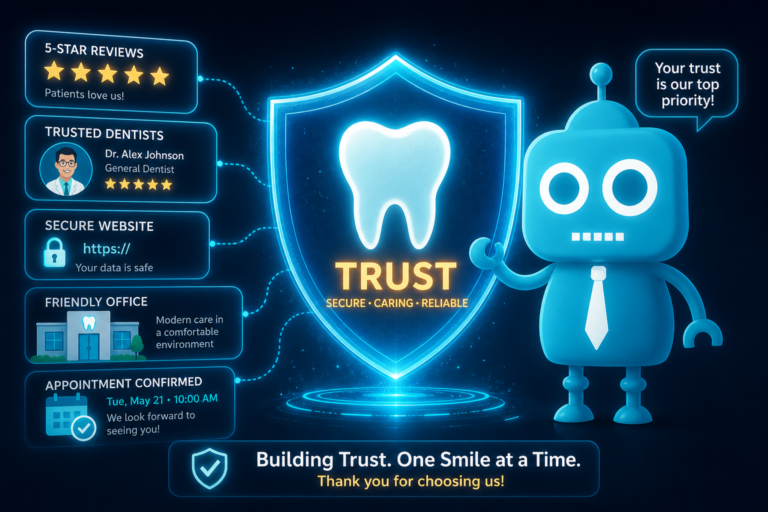
Patients are constantly looking for trust signals. Some are obvious, like star ratings. Others are subtle, like whether your website loads quickly on a phone or whether your appointment form feels easy to use.
Strong trust signals reduce doubt. Weak or missing trust signals create hesitation.
Important Trust Signals for Dental Practices
- Google review rating: Patients want to see that others had a good experience.
- Review quantity: A 5-star rating with 8 reviews is not as persuasive as a 4.8 rating with hundreds of reviews.
- Recent reviews: Patients want proof your office is still delivering a good experience now.
- Specific review content: Mentions of gentle care, friendly staff, clear pricing, and anxiety relief are powerful.
- Professional website design: Your website should make the practice look current, organized, and credible.
- Mobile optimization: Many dental searches happen on smartphones, especially urgent searches.
- Clear service pages: Patients need to quickly confirm that you provide the treatment they need.
- Easy contact options: Click-to-call buttons, appointment forms, and text-friendly workflows reduce friction.
- Provider bios: Patients want to know who will be treating them.
- Testimonials and patient stories: Social proof helps patients picture a successful outcome.
These trust signals work together. A great ad can bring patients to your practice, but trust signals help them decide, “This is the dental office I should call.”
Google Maps Is Now a Reputation Platform, Not Just a Location Tool
For local dental SEO, Google Maps is one of the most important places where reputation influences patient behavior.
When patients search for a nearby dentist, Google Maps often appears before traditional website results. That means your Google Business Profile may be the first impression of your practice.
What Patients Notice on Google Maps
Patients are not only checking your address. They are evaluating your practice based on:
- Your average star rating
- Your total number of reviews
- How recent your reviews are
- Whether your team responds to reviews
- Your office photos
- Your listed services
- Your hours of operation
- Whether your phone number and website are easy to access
- Your proximity to their home, work, or child’s school
If your practice appears on Google Maps but has fewer reviews than nearby competitors, patients may never make it to your website. They may choose another office before they even compare your services.
This is why dental reputation management and Google Maps optimization should be connected. Your profile needs accurate information, strong visuals, current services, consistent review generation, and active review responses.
Social Proof Makes Patients Feel Safer
Dental patients often have unspoken concerns. They may wonder:
- Will this dentist be gentle?
- Will the front desk be helpful with insurance?
- Will I feel judged if I have not been to the dentist in years?
- Will treatment be explained clearly?
- Will the office try to pressure me into unnecessary care?
- Can I trust this practice with my child, parent, or spouse?
Social proof answers these questions better than an advertisement can.
An ad may say, “Gentle family dentist accepting new patients.” A review saying, “I was nervous because I hadn’t been to the dentist in 10 years, but the hygienist and doctor made me feel comfortable and explained everything clearly,” is far more persuasive.
How Dental Practices Can Use Social Proof Effectively
Social proof should appear throughout your digital presence, including:
- Google Business Profile reviews
- Website testimonials
- Service pages for implants, Invisalign, cosmetic dentistry, emergency dentistry, and family care
- Homepage sections highlighting patient experience
- Email follow-up campaigns
- Social media posts, when appropriate and compliant
- New patient landing pages
The goal is not to overwhelm patients with praise. The goal is to reduce uncertainty at the exact moments when they are deciding whether to book.
Website Testimonials Help Convert Visitors Into New Patient Leads
Your website should not function like a static brochure. It should act as a conversion tool for new patient acquisition.
When a potential patient lands on your website from Google, an ad, or Google Maps, testimonials can reinforce the trust they started building through reviews. This is especially important on high-intent service pages.
Where Testimonials Should Appear on a Dental Website
Website testimonials are most effective when placed near decision points, such as:
- Homepage: Include a short review section that immediately communicates patient satisfaction.
- New patient page: Use testimonials that mention comfort, friendliness, and easy scheduling.
- Emergency dentistry page: Highlight reviews about fast appointments, pain relief, and compassionate care.
- Cosmetic dentistry page: Include testimonials about confidence, smile results, and clear communication.
- Dental implants page: Use patient feedback that mentions trust, treatment planning, and long-term results.
- Contact page: Add reassurance near the appointment form to encourage submission.
For example, a contact page with only a form may feel cold. A contact page with a testimonial beside the form saying, “The front desk helped me schedule quickly and explained my insurance before my visit,” can make the next step feel easier.
Referral Validation: Even Word-of-Mouth Patients Check Your Reputation
Referrals are still one of the strongest sources of new dental patients. But referrals now work differently than they did years ago.
When someone recommends your practice, the referred patient often validates that recommendation online before calling. They search your practice name, read reviews, visit your website, and check whether your office feels like the right fit.
This means your online reputation supports your offline referrals.
Example: The Modern Dental Referral Journey
A patient tells a coworker, “You should go to my dentist. They’re great.”
The coworker does not immediately call. They search the practice on Google. They see the reviews, look at photos, check the website, read about the dentist, and confirm whether the office accepts new patients.
If everything looks current and trustworthy, the referral becomes a booked appointment. If the website looks outdated, reviews are mixed, or contact options are unclear, the referral may stall.
That is referral validation. Your reputation either strengthens the recommendation or weakens it.
Acquisition Friction Is the Hidden Reason Patients Do Not Book
Many dental practices focus on generating more leads but overlook the friction that prevents leads from becoming appointments.
Acquisition friction is anything that makes it harder for a prospective patient to schedule. It can happen on your Google profile, website, phone system, contact forms, CRM process, or front desk workflow.
Common Sources of Acquisition Friction in Dental Practices
- An outdated website that does not build confidence
- Slow mobile load times
- No visible click-to-call button on mobile
- Appointment forms that are too long or confusing
- No text messaging option for patients who prefer SMS
- Contact forms that do not connect to a CRM or follow-up workflow
- Missed calls during busy front desk periods
- Delayed responses to new patient inquiries
- Inconsistent review requests after appointments
- Negative reviews with no professional response
- Service pages that lack clear explanations or calls to action
Every point of friction gives the patient a reason to pause, compare, or choose another office.
For example, if a patient submits a website form for a dental implant consultation and does not hear back until the next afternoon, they may have already contacted another practice. Speed matters. So does the quality of the follow-up.
Your Front Desk Is Part of Your Reputation Strategy
Reputation is not only built online. It is built through daily operations, especially at the front desk.
Your front desk team influences reviews, referrals, and conversions in direct ways. They answer first-time patient questions, explain insurance basics, manage scheduling, respond to missed calls, and help patients feel welcome before they ever sit in the chair.
Front Desk Moments That Affect Reputation
- How quickly calls are answered
- Whether voicemail messages are returned promptly
- How new patient inquiries from website forms are handled
- Whether patients receive appointment confirmations
- How clearly insurance and payment questions are explained
- How the team asks satisfied patients for reviews
- How complaints are handled before they become public reviews
A practice can have strong clinical care but still lose new patients if front desk systems are inconsistent. That is why website forms, CRM integrations, SMS reminders, email follow-ups, and review requests should support the team instead of adding more manual work.
Review Automation Helps Build Reputation Consistently
Most happy patients are willing to leave a review, but they often need a simple prompt at the right time.
Relying on staff to manually ask every patient is difficult. The front desk is busy. Hygienists are turning rooms. Doctors are moving between operatories. Review requests get forgotten.
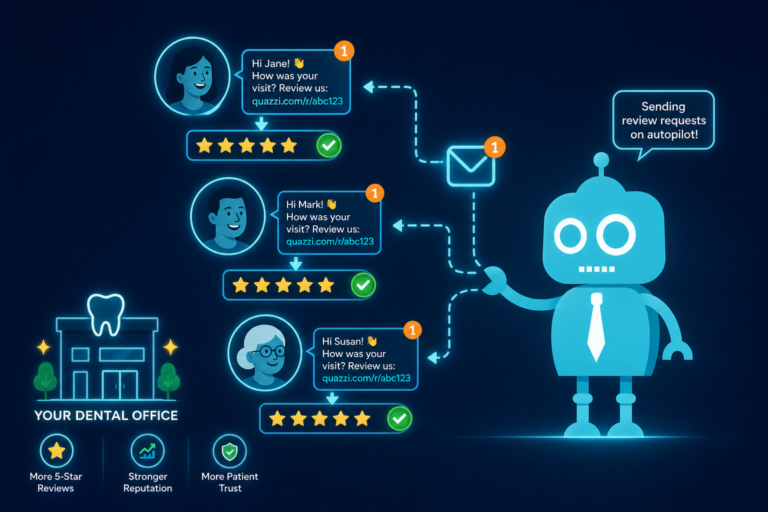
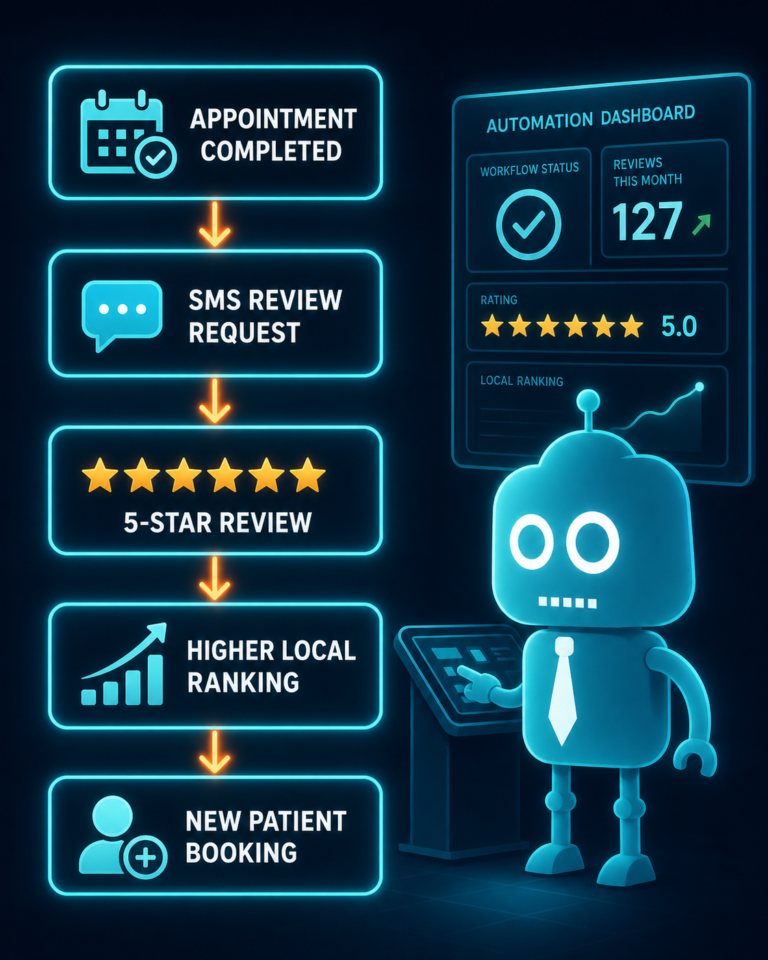
Review automation solves this by creating a consistent process.
How Review Automation Works for Dental Practices
A typical automated review workflow may include:
- A patient completes an appointment.
- The practice management system or CRM triggers a follow-up.
- The patient receives an SMS or email thanking them for visiting.
- The message includes a direct link to leave a Google review.
- If the patient does not respond, a gentle reminder can be sent later.
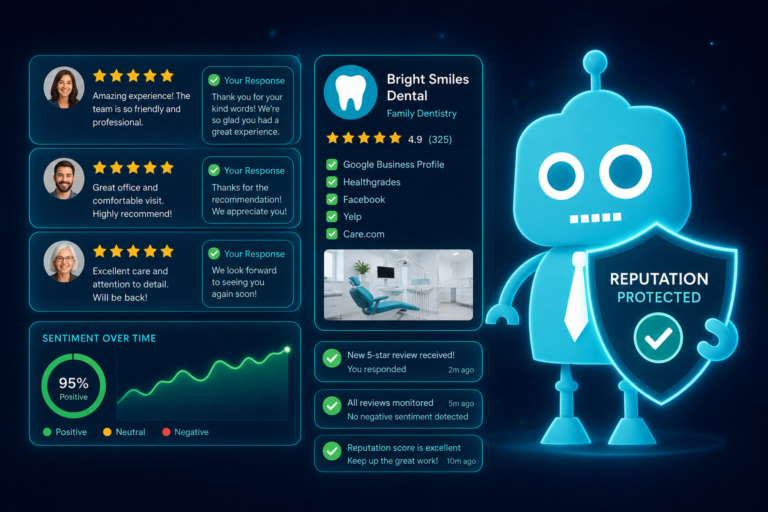
- The practice monitors new reviews and responds professionally.
This type of workflow helps practices generate reviews more reliably without putting all the responsibility on the front desk.
The timing matters. A review request sent shortly after a positive visit is more likely to be completed than one sent days or weeks later. SMS often works well because patients can tap the link quickly from their phone.
Best Practices for Dental Review Requests
- Ask shortly after the appointment, while the experience is fresh.
- Use a direct Google review link to reduce steps.
- Keep the message short and sincere.
- Do not pressure patients or offer incentives for reviews.
- Train the team to identify positive patient moments.
- Respond to reviews in a professional, HIPAA-conscious way.
- Track review growth monthly as a marketing metric.
Review automation is not about manufacturing reputation. It is about making it easier for satisfied patients to share real experiences.
Reputation Improves the ROI of Dental Advertising
Advertising and reputation should not be treated as competitors. The strongest dental marketing strategies use both.
Advertising helps your practice reach people who need a dentist. Reputation helps those people choose you.
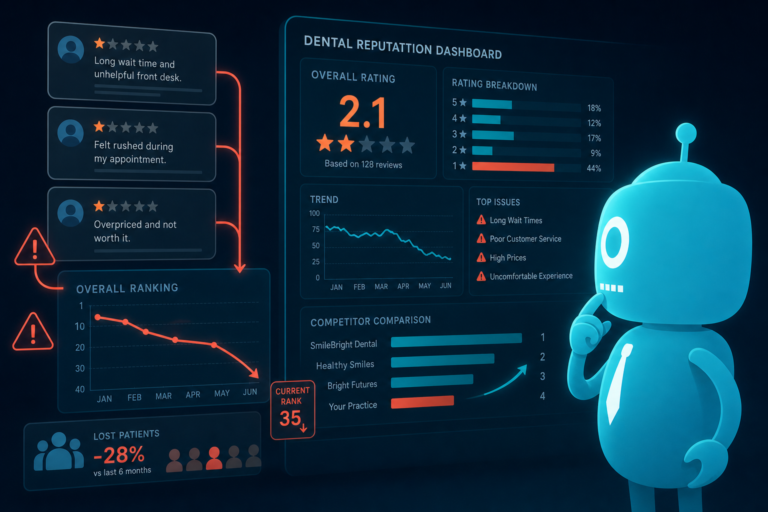
When your reputation is strong, your advertising budget can work harder because more clicks become calls, forms, and scheduled appointments. When your reputation is weak, you may pay for traffic that does not convert.
How Reputation Supports Paid Ads
- Patients who see your ad are more likely to trust your practice after checking reviews.
- Landing pages with testimonials can improve conversion rates.
- Strong Google reviews can increase confidence for high-value services like implants or Invisalign.
- Fast CRM follow-up can prevent paid leads from going cold.
- SMS and email automation can nurture patients who are interested but not ready to book immediately.
For example, a patient who clicks an ad for emergency dentistry may need immediate reassurance. If your landing page loads fast, shows strong reviews, includes a click-to-call button, and clearly states same-day appointment availability, that patient is more likely to call.
How to Strengthen Your Dental Practice Reputation Online
Improving reputation does not require a complete overhaul overnight. It requires a clear system and consistent execution.
1. Audit Your Current Reputation
Start by reviewing how your practice appears from a patient’s perspective. Search your practice name, your top services, and “dentist near me” in your area.
Look at your Google rating, review count, recent reviews, website design, mobile performance, service pages, and contact process. Compare your presence to nearby competitors.
2. Optimize Your Google Business Profile
Make sure your name, address, phone number, hours, website link, services, and photos are accurate. Add current images of the office, team, reception area, and exterior so patients know what to expect.
3. Build Reviews Into the Patient Workflow
Do not leave review generation to chance. Use SMS and email automation to request reviews after appointments. Train your team to mention reviews naturally when patients express appreciation.
4. Upgrade Your Website Trust Signals
Your website should clearly communicate who you are, what you offer, why patients trust you, and how to book. Add testimonials, dentist bios, service-specific content, clear calls to action, and mobile-friendly appointment forms.
5. Connect Website Forms to a CRM
When a new patient submits a form, that lead should not sit in an inbox. CRM integrations can help your team track inquiries, assign follow-up, send automated confirmations, and prevent leads from being missed.
6. Use SMS and Email Follow-Up
Patients are busy. Automated SMS and email workflows can confirm appointment requests, remind patients to complete forms, follow up after consultations, and request reviews after visits.
7. Respond to Reviews Professionally
Review responses show prospective patients that your practice is attentive. Keep responses brief, professional, and compliant. Avoid confirming private patient details or discussing treatment specifics publicly.
The Practices That Win Will Be the Ones Patients Trust Fastest
Patients have more choices than ever. They can compare dentists in seconds. They can read reviews while sitting in their car. They can leave your website if it feels outdated or confusing. They can contact another office if your team does not follow up quickly.
That does not mean advertising is no longer useful. It means advertising must be supported by reputation, website conversion, automation, and strong front desk systems.
The dental practices that grow consistently will be the ones that make trust easy. They will show strong reviews on Google Maps, use testimonials on their websites, respond quickly to inquiries, automate review requests, and remove friction from the appointment process.
Awareness gets attention. Reputation earns action.
Build a Dental Website and Reputation System That Converts
If your dental practice is investing in marketing, your website and follow-up systems need to support that investment. A modern website should do more than look good. It should help patients trust your practice, contact your team, and move smoothly from interest to appointment.
CreateTheSite.com helps dental practices with modern website design, secure hosting, mobile optimization, lead capture forms, CRM integrations, SMS and email automation, appointment follow-up, and ongoing website support.
Whether you want to improve new patient conversion, strengthen your online presence, streamline front desk follow-up, or make review generation more consistent, CreateTheSite.com can help you build a digital foundation that supports real practice growth.
When patients find you online, make sure they see a practice they can trust. Visit CreateTheSite.com to learn how a better dental website and smarter automation can help turn more interest into booked appointments.