How Recall Campaigns Improve Dental Revenue
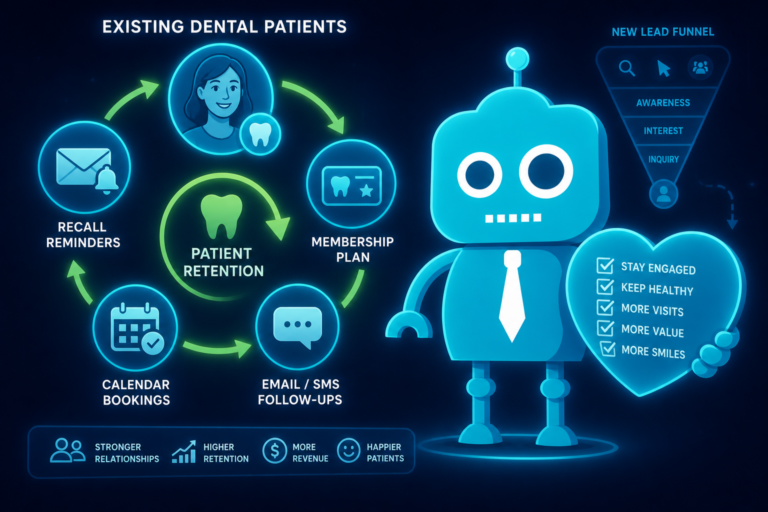
For independent dental practices, revenue consistency is often less about finding one big source of new patients and more about keeping existing patients on schedule. A strong recall campaign does exactly that.
When hygiene patients return every six months, perio patients maintain their recommended intervals, and families schedule together, the practice becomes less dependent on last-minute openings, inconsistent new patient flow, or front desk heroics. Recall campaigns stabilize production by bringing patients back before the schedule starts to thin out.
For dentists, office managers, and practice owners, recall is not just an administrative task. It is a revenue system.
Why Patients Fall Behind on Dental Visits
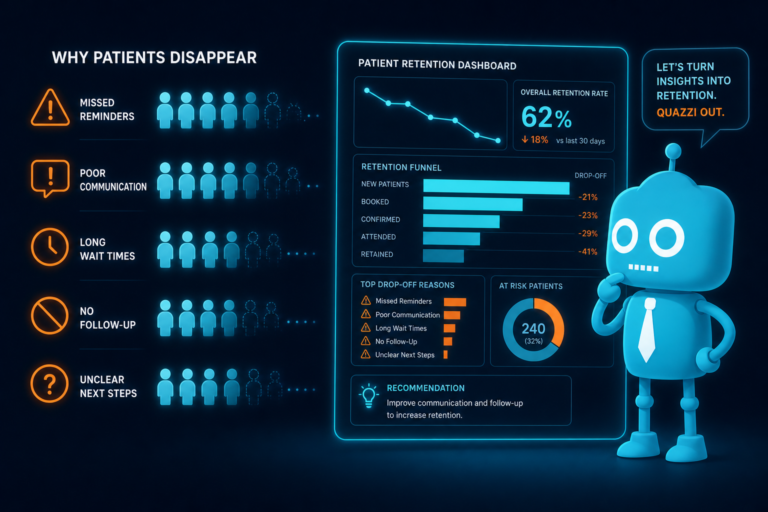
Most patients do not intentionally disappear from the schedule. They fall behind because life gets busy, communication gets missed, or the next appointment was never clearly secured.
Common reasons dental patients become overdue include:
- No appointment was scheduled before they left the office. If the patient walks out without a future appointment, the odds of delay increase.
- They missed a reminder. A single postcard, voicemail, or email is easy to overlook.
- Insurance confusion. Patients may not understand their remaining benefits or preventive coverage.
- Family scheduling challenges. Parents may delay because coordinating multiple children is inconvenient.
- Fear or avoidance. Patients who know they need treatment may postpone hygiene visits too.
- They switched phones or emails. Bad contact data quietly weakens recall performance.
- The practice did not follow up consistently. The front desk may be too busy managing calls, check-in, insurance, and same-day issues.
When enough patients fall behind, the impact shows up in production. Hygiene openings increase. Same-day treatment opportunities decrease. Case acceptance slows because fewer patients are in the chair. The doctor schedule becomes harder to fill with diagnosed treatment.
Recall Campaigns Create Predictable Dental Production
A healthy recall system helps turn your patient base into a more predictable production engine. Instead of reacting to empty hygiene slots a few days before they happen, your practice is consistently nudging patients back onto the schedule weeks or months in advance.
That matters because recall appointments often lead to additional revenue beyond the prophy or perio maintenance visit. During a routine visit, the team may identify restorative needs, cosmetic opportunities, periodontal issues, nightguard needs, whitening interest, or replacement of failing dental work.
For example, a patient who is three months overdue for hygiene may also have an aging crown margin, sensitivity on a molar, or interest in clear aligners. If that patient does not return, the practice loses more than a cleaning appointment. It loses diagnostic opportunities, treatment planning conversations, and future production.
Automated Recall Reminders Reduce Front Desk Workload
Manual recall calling still has value, but relying on manual effort alone is risky. Front desk teams are already managing phones, insurance verification, checkouts, patient questions, reviews, and schedule changes. Recall can easily get pushed aside.
Automated recall reminders help create consistency.
What Automated Recall Reminders Can Do
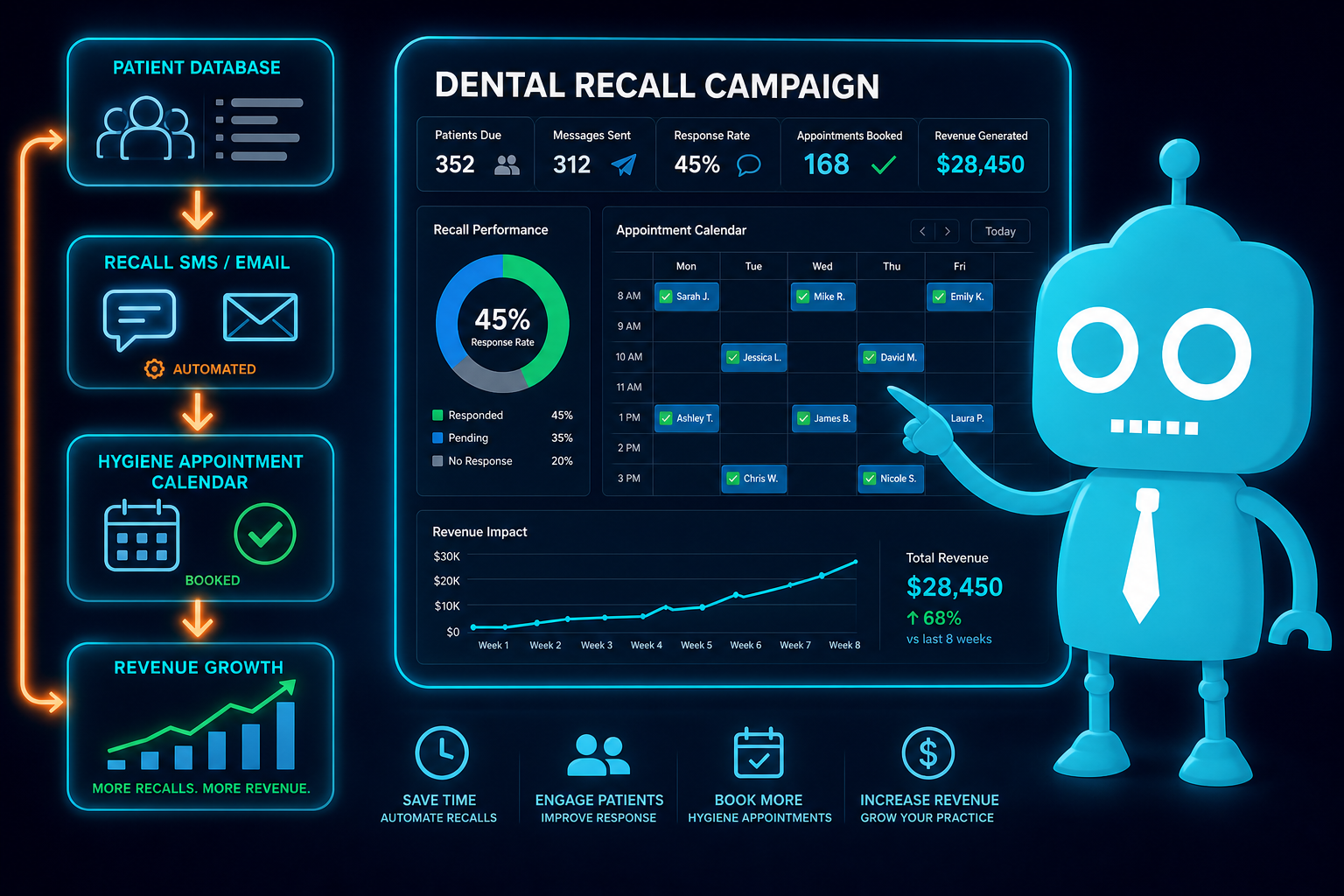
With the right CRM system, patient communication software, or dental marketing automation setup, recall reminders can be sent automatically based on the patient’s due date or last completed appointment.
For example:
- A hygiene patient receives a reminder four weeks before they are due.
- If they do not schedule, they receive a second message two weeks later.
- If there is still no response, the system sends a text with a scheduling link.
- The front desk receives a task only when personal follow-up is needed.
This approach helps the office stay proactive without asking the team to manually track every overdue patient. Automation handles the repetitive follow-up, while your staff focuses on higher-value conversations.
Automated Recall Works Best With Accurate Patient Data
Before launching a recall campaign, practices should review the quality of patient records. Make sure mobile numbers, email addresses, family relationships, appointment history, and communication preferences are accurate.
A recall campaign is only as strong as the data behind it. If your dental website lead forms, CRM integrations, and practice management system are not aligned, patients may fall through the cracks after their first appointment.
SMS and Email Follow-Up Bring Patients Back Faster
Patients respond differently depending on their habits. Some prefer text. Others still check email for appointment details, insurance information, or family scheduling. A strong dental recall campaign uses both SMS and email strategically.
Why SMS Works for Recall
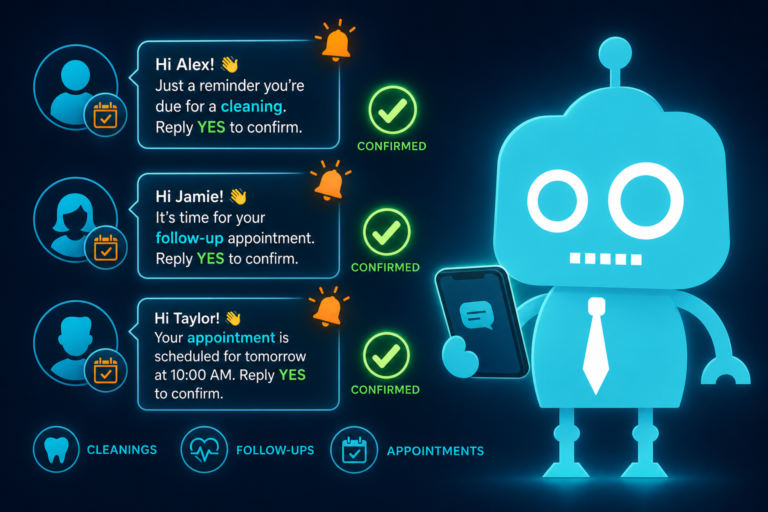
Text messaging is fast, direct, and convenient. Patients are more likely to see a text than answer an unknown phone call. SMS is especially effective when the message is simple and action-oriented.
Example SMS recall message:
Hi Sarah, you are due for your dental cleaning at Green Valley Dental. We have openings next Tuesday and Thursday. Reply SCHEDULE or call us at (555) 123-4567.
For practices with online scheduling or website appointment request forms, SMS can include a direct link:
You are due for your preventive visit. Request your appointment here: [link]
This reduces friction. Patients do not have to call during business hours. They can request an appointment from their phone while thinking about it.
Why Email Still Matters
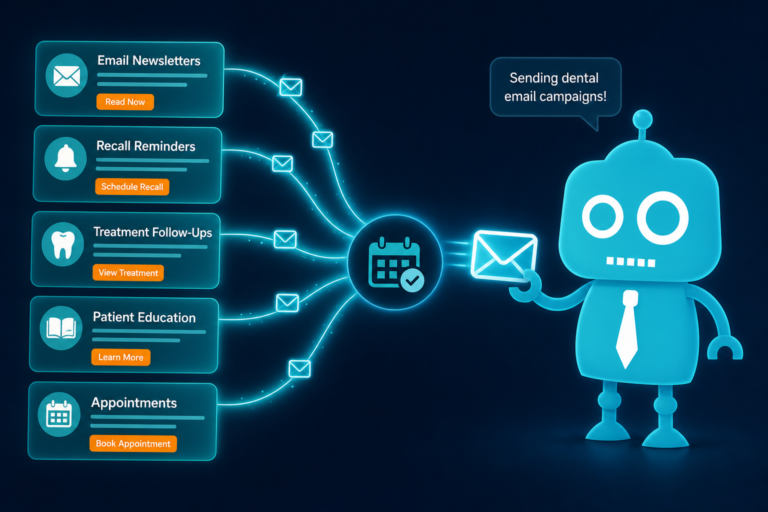
Email is useful for messages that need more context. It can explain insurance benefits, introduce a new hygienist, promote family scheduling days, or remind patients why preventive care matters.
Example email subject lines for dental recall campaigns:
- You’re Due for Your Dental Cleaning
- Let’s Get Your Next Visit Scheduled
- Use Your Dental Benefits Before They Reset
- Your Family May Be Due for Preventive Visits
- We Saved a Few Openings This Month
The best recall systems combine SMS and email with clear calls to action. Each message should make it easy to call, reply, or request an appointment online.
Missed Appointment Recovery Protects the Schedule
Missed appointments and last-minute cancellations are production leaks. If the office does not follow up quickly, the patient can drift from “temporarily unscheduled” to “inactive” before anyone notices.
A missed appointment recovery campaign helps bring those patients back before they become long-term reactivation candidates.
How to Follow Up After a Missed Dental Appointment
The first message should be timely and helpful, not judgmental.
Example SMS:
Hi James, we missed you at your appointment today. We hope everything is okay. Please reply to this text or call us at (555) 123-4567 so we can help you reschedule.
If there is no response, the system can send additional follow-ups over the next few days:
- Same day: friendly missed appointment message
- Next day: rescheduling reminder with available openings
- One week later: email explaining the importance of staying on schedule
- Two weeks later: front desk call task for personal outreach
This process keeps missed appointments from disappearing into the schedule history. It also helps recover hygiene production, protect provider time, and reduce gaps in patient care.
Family Recall Campaigns Increase Convenience and Production
Family recall campaigns are especially valuable for general dental practices. Parents often want to schedule multiple family members at once, but they may delay if the process feels complicated.
Instead of sending separate disconnected reminders for each patient, your system can identify households and encourage group scheduling.
Example Family Recall Message
Hi Amanda, it looks like you and two family members may be due for preventive dental visits. We can help coordinate appointments together or on the same day. Reply FAMILY and our team will help schedule convenient times.
This type of messaging makes the practice feel organized and helpful. It also benefits production because family blocks can fill larger openings, improve hygiene utilization, and reduce scattered scheduling.
Family Recall Campaigns Help the Front Desk
Without a structured campaign, family scheduling often requires multiple phone calls and manual chart reviews. With CRM-supported recall workflows, the team can see which family members are due, overdue, or already scheduled.
This improves front desk efficiency and gives patients a better experience. Instead of saying, “Let me check everyone’s chart,” the team can proactively say, “It looks like Emma is due now, and Jacob will be due next month. Would you like to coordinate both visits?”
Reactivation Campaigns Bring Back Inactive Dental Patients
Recall campaigns focus on patients who are due or recently overdue. Reactivation campaigns target patients who have been gone longer, often 12, 18, or 24 months.
Inactive patients are valuable because they already know your practice. They may have delayed care because of insurance changes, moving within the area, fear, finances, or simply losing track of time. Compared to new patient acquisition, reactivation can be more cost-effective because the relationship already exists.
How to Segment Reactivation Campaigns
Not every inactive patient should receive the same message. Segmenting your patient list improves results.
- 12 months overdue: Friendly reminder to get back on schedule.
- 18 months overdue: Message emphasizing preventive care and updated appointment availability.
- 24+ months overdue: “We’d love to welcome you back” campaign with a simple scheduling path.
- Patients with incomplete treatment: Personalized follow-up about diagnosed care, financing, or consultation options.
- Families inactive together: Family reactivation message with coordinated scheduling.
Example Reactivation Email
Subject: We’d Love to See You Back at Our Office
Hi Michael, it has been a while since your last dental visit with us. If you have been meaning to get back on schedule, we would be happy to help. Our team can check your benefits, answer questions, and find an appointment time that works for you. Request a visit here or call us at (555) 123-4567.
The goal is to lower the barrier to return. Avoid guilt-based messaging. Patients who feel embarrassed about being overdue need reassurance, not pressure.
Recall Campaigns Support New Patient Acquisition
Many practices think of recall and new patient marketing as separate efforts. In reality, they support each other.
When your existing patients stay active, your schedule becomes more stable. That stability gives your team more control over where new patients fit. It also improves the return on your dental website and marketing campaigns because new patient leads are not being used to constantly replace inactive patients.
A modern dental website should support both new patient conversion and existing patient recall. That means your site should make it easy for patients to:
- Request an appointment from a mobile device
- Click to call the office
- Submit a secure lead or appointment form
- Find insurance and financing information
- Read recent patient reviews
- Access patient forms
- Reconnect if they are overdue
If your recall emails and texts send patients to a slow, outdated, or confusing website, conversion suffers. A strong recall campaign needs a strong digital destination.
Reviews Can Strengthen Recall Campaign Results
Reviews are often associated with attracting new patients, but they can also influence returning patients. If someone has not visited in over a year, seeing recent positive reviews can reassure them that the practice is active, trusted, and still delivering a good experience.
For example, a reactivation email can link to a page with patient reviews, doctor bios, updated office photos, and clear appointment request options. This is especially helpful if the practice has changed providers, expanded services, or improved technology.
Front desk teams can also use recall interactions to generate reviews from satisfied patients. After a successful hygiene visit, an automated review request can be sent by SMS or email. More positive reviews improve local SEO, website conversion, and patient confidence.
How Recall Campaigns Improve Production Stability
The biggest financial benefit of recall campaigns is production stability. A full hygiene schedule creates steady baseline revenue and feeds the doctor schedule with diagnosed treatment.
When recall is weak, the practice becomes reactive. The team scrambles to fill holes, relies heavily on new patient flow, and loses production when overdue patients delay care. When recall is strong, the practice has a more dependable rhythm.
Recall Stabilizes Hygiene Production
Hygiene is one of the most predictable production centers in a dental practice. Keeping patients on their recommended intervals helps maintain consistent daily and monthly production.
Even a small improvement can matter. If a practice recovers 20 overdue hygiene patients per month, and each visit leads to hygiene production plus periodic exams, radiographs, fluoride, perio maintenance, or treatment diagnosis, the revenue impact compounds quickly.
Recall Feeds Restorative and Treatment Production
Patients cannot accept treatment that has not been diagnosed. Regular recall visits create opportunities for exams, updated radiographs, intraoral photos, and treatment conversations.
A patient returning for a routine visit may need a crown, filling, implant consultation, nightguard, scaling and root planing, or cosmetic treatment. This is why recall campaigns affect more than hygiene. They influence the entire production pipeline.
Recall Reduces Schedule Volatility
Dental practices with inconsistent recall often experience production swings. One week is full. The next week has openings. The team feels busy, but monthly numbers remain unpredictable.
Consistent recall campaigns smooth out those swings by keeping patients moving through the schedule at the right intervals. This makes it easier to plan staffing, manage provider time, track goals, and forecast revenue.
Practical Recall Campaign Workflow for Dental Practices
A successful recall system does not need to be complicated. It needs to be consistent, trackable, and easy for patients to act on.
Step 1: Identify Due and Overdue Patients
Pull lists from your practice management system or CRM. Segment patients by due date, overdue status, provider, family, and treatment status.
Step 2: Confirm Contact Information
Train the front desk to verify mobile numbers and email addresses at every visit. Bad data is one of the most common reasons recall campaigns underperform.
Step 3: Send Automated SMS and Email Reminders
Use automated workflows to contact patients before they are due, when they become due, and after they are overdue. Include a simple call to action in every message.
Step 4: Route Responses to the Front Desk
Make sure replies, appointment requests, and lead forms are easy for the team to manage. A recall campaign should not create confusion or duplicate work.
Step 5: Recover Missed Appointments Quickly
Trigger same-day follow-up for no-shows and cancellations. The faster the response, the more likely the patient is to reschedule.
Step 6: Run Monthly Reactivation Campaigns
Do not wait until the schedule is empty. Contact inactive patients every month with segmented, friendly messages.
Step 7: Track Results
Monitor how many patients were contacted, how many responded, how many scheduled, and how much production was recovered. Over time, this helps refine messaging and timing.
What to Measure in a Dental Recall Campaign
To improve recall performance, practices should measure more than message volume. Focus on outcomes.
- Recall appointment rate: Percentage of due patients who schedule.
- Overdue patient recovery: Number of overdue patients brought back each month.
- No-show recovery rate: Percentage of missed appointments rescheduled.
- Reactivation rate: Inactive patients who return after campaigns.
- Hygiene utilization: Percentage of available hygiene time filled.
- Treatment diagnosed from recall visits: Production opportunities identified.
- Website conversion rate: Patients who click from SMS or email and submit an appointment request.
- Review growth: New reviews generated after completed visits.
These metrics help practice owners and office managers see recall as a production system, not just a reminder process.
Common Recall Campaign Mistakes to Avoid
Recall campaigns can underperform when they are too generic, too infrequent, or too hard for patients to act on.
Sending Only One Reminder
One message is not enough. Patients are busy. A multi-touch sequence across SMS, email, and personal follow-up will usually perform better.
Using Vague Calls to Action
Messages like “Call us when you can” are weaker than “Reply SCHEDULE” or “Request your appointment here.” Make the next step obvious.
Not Connecting Campaigns to the Website
If patients click from a text or email, the landing page should load quickly, work on mobile, and include a simple appointment request form. A poor website can waste recall opportunities.
Ignoring Family Relationships
Families often prefer coordinated appointments. Treating each family member as a separate recall opportunity can make scheduling harder than necessary.
Failing to Follow Up on Form Submissions
If a patient submits an appointment request through your website, the front desk needs to respond quickly. CRM notifications, automated confirmations, and task assignments can prevent leads from sitting unnoticed.
Recall Campaigns Turn Patient Relationships Into Reliable Revenue
Independent dental practices do not need to rely only on new patient advertising to grow. Many already have significant revenue sitting inside their existing patient base. The opportunity is bringing those patients back on schedule consistently.
Automated recall reminders, SMS and email follow-up, missed appointment recovery, family recall campaigns, and reactivation workflows all help stabilize production. They keep hygiene chairs full, create more diagnostic opportunities, support treatment planning, and reduce monthly revenue volatility.
For a dental practice, recall is not just about reminding patients. It is about building a more predictable schedule, a stronger patient experience, and a healthier business.
Improve Dental Recall Campaigns With CreateTheSite.com
CreateTheSite.com helps dental practices build the digital systems that make recall campaigns more effective. A patient reminder is only valuable if it leads to a smooth scheduling experience, a mobile-friendly website, and reliable follow-up from the office.
Our team helps independent dental practices with modern website design, secure hosting, mobile optimization, lead capture forms, CRM integrations, SMS and email automation, appointment follow-up, and ongoing website support.
Whether you want to convert more new patients, reactivate overdue patients, improve website appointment requests, or connect your front desk with better follow-up tools, CreateTheSite.com can help you build a stronger online foundation for practice growth.
Ready to make your dental website and recall follow-up work together? Visit CreateTheSite.com to learn how we can support your practice with smarter design, better automation, and a more reliable patient conversion system.